


battery: the most important part of a car


Administrator
Joined: Jun 2009
Posts: 13,972
Likes: 1,296
From: Fort Worth, Texas

Thread Starter
|
Senior Member
Joined: Jun 2019
Posts: 1,047
Likes: 40
From: windsor ontario next to detroit
 Re: battery: the most important part of a car
a brief explanation of a battery, like the 1 in our car:
(Lead-acid)
Tried, tested, and trusted, lead-acid batteries have been with us since the middle of the 19th century. With an overall rating of 12 volts, they have six separate cells, each producing 2 volts. Crudely reduced to its basic components, each cell has a "spongy" lead metal electrode (negative), a lead dioxide electrode (positive), and a sulfuric acid electrolyte. As the battery discharges, both electrodes become coated with lead sulfate and the sulfuric acid is largely converted into water, while electrons flow out around the external circuit to provide power.
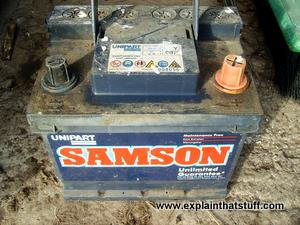
Photo: A typical lead-acid car battery (accumulator).
If you look closely, you can see the negative terminal (black, marked with a − sign, left) and positive terminal (red, marked with a + sign, right) on top.
Lead-acid batteries made it possible to start cars without the help of a dangerous and dirty hand crank. Normally, you never have to recharge them—because your car does that automatically. The battery discharges (gives up a little of its energy) to help the car's gasoline engine start up, and recharges (gets energy back again) when the engine begins generating electrical energy through a device called an alternator. As for disadvantages, lead-acid batteries are relatively big, surprisingly heavy (try lifting one!), expensive, and can't be fully charged and discharged too many times. Another problem is their use of toxic lead metal, which can cause environmental problems when they're dumped in landfills.
https://www.explainthatstuff.com/batteries.html
(Lead-acid)
Tried, tested, and trusted, lead-acid batteries have been with us since the middle of the 19th century. With an overall rating of 12 volts, they have six separate cells, each producing 2 volts. Crudely reduced to its basic components, each cell has a "spongy" lead metal electrode (negative), a lead dioxide electrode (positive), and a sulfuric acid electrolyte. As the battery discharges, both electrodes become coated with lead sulfate and the sulfuric acid is largely converted into water, while electrons flow out around the external circuit to provide power.
Photo: A typical lead-acid car battery (accumulator).
If you look closely, you can see the negative terminal (black, marked with a − sign, left) and positive terminal (red, marked with a + sign, right) on top.
Lead-acid batteries made it possible to start cars without the help of a dangerous and dirty hand crank. Normally, you never have to recharge them—because your car does that automatically. The battery discharges (gives up a little of its energy) to help the car's gasoline engine start up, and recharges (gets energy back again) when the engine begins generating electrical energy through a device called an alternator. As for disadvantages, lead-acid batteries are relatively big, surprisingly heavy (try lifting one!), expensive, and can't be fully charged and discharged too many times. Another problem is their use of toxic lead metal, which can cause environmental problems when they're dumped in landfills.
https://www.explainthatstuff.com/batteries.html
Last edited by phil alvirez; Dec 19, 2020 at 01:55 PM.
Thread Starter
|
Senior Member
Joined: Jun 2019
Posts: 1,047
Likes: 40
From: windsor ontario next to detroit
Re: battery: the most important part of a car
1 of the major factors that contribute to the demise of a battery is:
Acid stratification happens in every lead acid battery when the heavier acid in the battery's electrolyte separates from the water and assembles at the bottom of the battery's cells creating an area of very high specific gravity electrolyte.
but then, if using AGM technology, it suspends all of the battery's electrolyte in an absorbed glass mat that slows the heavier acids ability to separate from the water and to settle at the bottom of the battery's cells. By eliminating or slowing acid stratification the battery maintains uniform charge and discharge activity across the whole of the battery's plates. Eliminating acid stratification improves active material utilization, sustains Dynamic Charge Acceptance and cycle life and prevents premature loss of performance and life.
https://batteryuniversity.com/learn/...w%20discharges.
Acid Stratification
The electrolyte of a stratified battery concentrates at the bottom, starving the upper half of the cell. Acid stratification occurs if the battery dwells at low charge (below 80 percent), never receives a full charge and has shallow discharges. Driving a car for short distances with power-robbing accessories engaged contributes to acid stratification because the alternator cannot always apply a saturated charge. Large luxury cars are especially prone to acid stratification. This is not a battery defect per se but is application related.Acid stratification happens in every lead acid battery when the heavier acid in the battery's electrolyte separates from the water and assembles at the bottom of the battery's cells creating an area of very high specific gravity electrolyte.
but then, if using AGM technology, it suspends all of the battery's electrolyte in an absorbed glass mat that slows the heavier acids ability to separate from the water and to settle at the bottom of the battery's cells. By eliminating or slowing acid stratification the battery maintains uniform charge and discharge activity across the whole of the battery's plates. Eliminating acid stratification improves active material utilization, sustains Dynamic Charge Acceptance and cycle life and prevents premature loss of performance and life.
https://batteryuniversity.com/learn/...w%20discharges.
Last edited by phil alvirez; Dec 19, 2020 at 02:08 PM.
Thread Starter
|
Senior Member
Joined: Jun 2019
Posts: 1,047
Likes: 40
From: windsor ontario next to detroit
Re: battery: the most important part of a car
another factor that shortens the life of a battery is sulphation.
Replacement batteries cost a lot of money and everybody knows that batteries wear out over time. What most people don't know is that more than 70% of lead acid batteries fail because of sulphate build up on the cells, not because they are worn out. Sulphate build up increases the internal resistance of the battery, reducing its capacity and leads to premature battery failure. You can stop sulphate build up on new batteries which could double the life of your batteries; in effect this will reduce your battery costs by 50%. The main causes of sulphate build up on lead acid battery cells are: Batteries sitting too long between charges, storing batteries without charging, undercharging batteries, low electrolyte level and incorrect charging levels. problem is, there are lots of products that tell they work, but also there is a lot of conflictive advertising. some talk about bursts of high voltage, even at least 1 that tells that they have a patented device that use a range of high frequencies. but when trying to get confirmation about this, they didnt provide it, so we still are in the dark. and none can prove anything.
intriguing subject, but no light on it so far. You also see pulse circuits or pulsers. they may help a little but don’t fully solve the problem. Most of these pulse circuit devices send a high voltage current into the battery which will break down some of the sulphate build up on the positive battery plate but the high voltage spikes they generate will also damage the battery in the long term.
Several companies offer anti-sulfation devices that apply pulses to the battery terminals to prevent and reverse sulfation. Such technologies will lower the sulfation on a healthy battery, but they cannot effectively reverse the condition once present. It’s a “one size fits all” approach and the method is unscientific. and again, none bring data to prove it. no way to check what-if any-they do.
https://batteryvitamin.net/sulfation...tment_surprise
Replacement batteries cost a lot of money and everybody knows that batteries wear out over time. What most people don't know is that more than 70% of lead acid batteries fail because of sulphate build up on the cells, not because they are worn out. Sulphate build up increases the internal resistance of the battery, reducing its capacity and leads to premature battery failure. You can stop sulphate build up on new batteries which could double the life of your batteries; in effect this will reduce your battery costs by 50%. The main causes of sulphate build up on lead acid battery cells are: Batteries sitting too long between charges, storing batteries without charging, undercharging batteries, low electrolyte level and incorrect charging levels. problem is, there are lots of products that tell they work, but also there is a lot of conflictive advertising. some talk about bursts of high voltage, even at least 1 that tells that they have a patented device that use a range of high frequencies. but when trying to get confirmation about this, they didnt provide it, so we still are in the dark. and none can prove anything.
intriguing subject, but no light on it so far. You also see pulse circuits or pulsers. they may help a little but don’t fully solve the problem. Most of these pulse circuit devices send a high voltage current into the battery which will break down some of the sulphate build up on the positive battery plate but the high voltage spikes they generate will also damage the battery in the long term.
Several companies offer anti-sulfation devices that apply pulses to the battery terminals to prevent and reverse sulfation. Such technologies will lower the sulfation on a healthy battery, but they cannot effectively reverse the condition once present. It’s a “one size fits all” approach and the method is unscientific. and again, none bring data to prove it. no way to check what-if any-they do.
https://batteryvitamin.net/sulfation...tment_surprise
Last edited by phil alvirez; Dec 19, 2020 at 01:51 PM.
Thread Starter
|
Senior Member
Joined: Jun 2019
Posts: 1,047
Likes: 40
From: windsor ontario next to detroit
Re: battery: the most important part of a car
Anatomy of a Car Battery
now, wana see whats inside?
these are the components:
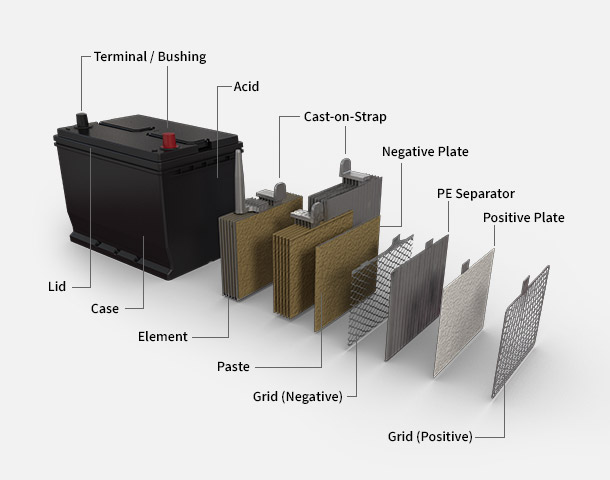
Battery Terminal/Bushing: The terminals are connected to the positive strap and the negative strap of the end cells, and are the interfacing point between the battery and the vehicle's electrical system.
Battery Acid: The acid is a high-purity solution of sulfuric acid and water.Cast-on Strap for Batteries: The cast-on straps are welded to the top of each element to provide an electrical connection to the terminals.
Battery Negative Plate: The negative plate contains a metal grid with spongy lead active material.
Battery Separator: The separator is a polyethylene material that separates the positive plates from the negative plates to provide an efficient flow of electrical current.
Positive Battery Plate: The positive plate contains a metal grid with lead dioxide active material.
Lid on Battery: The lid is made of polypropylene resin and sealed to the battery case.
Battery Case: The case is polypropylene resin, which holds the battery plates, cast-on straps and electrolyte. It's designed to minimize vibration impact and extend battery life.
Battery Plates: The element consists of stacked alternating positive and negative plates. The plates are connected at the top by a cast-on strap that is welded to the plates. The elements fit into the individual cells of each battery.
Battery Paste: The paste is a lead oxide mixture that creates both lead dioxide and sponge lead. It adheres to the positive and negative battery grids.
and here you can see the innards:
so there you have it ! more sophisticated than we expected, but as it works, hasnt been replaced...so far.
https://www.autobatteries.com/en-us/...s-work/anatomy
now, wana see whats inside?
these are the components:
Battery Terminal/Bushing: The terminals are connected to the positive strap and the negative strap of the end cells, and are the interfacing point between the battery and the vehicle's electrical system.
Battery Acid: The acid is a high-purity solution of sulfuric acid and water.Cast-on Strap for Batteries: The cast-on straps are welded to the top of each element to provide an electrical connection to the terminals.
Battery Negative Plate: The negative plate contains a metal grid with spongy lead active material.
Battery Separator: The separator is a polyethylene material that separates the positive plates from the negative plates to provide an efficient flow of electrical current.
Positive Battery Plate: The positive plate contains a metal grid with lead dioxide active material.
Lid on Battery: The lid is made of polypropylene resin and sealed to the battery case.
Battery Case: The case is polypropylene resin, which holds the battery plates, cast-on straps and electrolyte. It's designed to minimize vibration impact and extend battery life.
Battery Plates: The element consists of stacked alternating positive and negative plates. The plates are connected at the top by a cast-on strap that is welded to the plates. The elements fit into the individual cells of each battery.
Battery Paste: The paste is a lead oxide mixture that creates both lead dioxide and sponge lead. It adheres to the positive and negative battery grids.
and here you can see the innards:
so there you have it ! more sophisticated than we expected, but as it works, hasnt been replaced...so far.
https://www.autobatteries.com/en-us/...s-work/anatomy
Last edited by phil alvirez; Dec 19, 2020 at 01:36 PM.
Thread Starter
|
Senior Member
Joined: Jun 2019
Posts: 1,047
Likes: 40
From: windsor ontario next to detroit
Re: battery: the most important part of a car
the thing with names...
the batteries we use are for starting the engine and are called starter or starting batteries.
but there are 2 types of lead/acid batteries. the other is the so-called deep cycle aka motive power. so make sure you use the right words.
and when searching for data, this is crucial. easy to oversee this and reach the wrong conclusions-or buy the wrong thing.
even if both are lead/acid, they are made different.
originally were called accumulators (of energy, that is). and the name makes sense. but somehow the name battery catched up. so here we are. get used to it.
the batteries we use are for starting the engine and are called starter or starting batteries.
but there are 2 types of lead/acid batteries. the other is the so-called deep cycle aka motive power. so make sure you use the right words.
and when searching for data, this is crucial. easy to oversee this and reach the wrong conclusions-or buy the wrong thing.
even if both are lead/acid, they are made different.
originally were called accumulators (of energy, that is). and the name makes sense. but somehow the name battery catched up. so here we are. get used to it.
Last edited by phil alvirez; Dec 18, 2020 at 08:24 AM.



Senior Member
Joined: Apr 2006
Posts: 25,432
Likes: 649
From: Ontario

Senior Member
Joined: Dec 2010
Posts: 12,780
Likes: 185
From: Lineville, AL

Senior Member
Joined: Apr 2010
Posts: 2,404
Likes: 8
From: Mendocino, CA
Re: battery: the most important part of a car
Well, all I can add is that our OEM Varta batteries were awesome. I swapped it out after 12 years(figured I was pressing my luck), but I kept it charged and used it for a jumper batt. on various equipment and vehicles. It kept going for another 3 years; 15 years of service! Remarkable. My recent $230.AGM battery got me slightly under 4 years.
Thread Starter
|
Senior Member
Joined: Jun 2019
Posts: 1,047
Likes: 40
From: windsor ontario next to detroit
Re: battery: the most important part of a car
corrosion is another factor that greatly influences the life of a battery.
but again, there is something about the name, that makes things confusing.
corrosion is a chemical reaction to store electricity. is really oxidization of the positive plate grid surface.
but applying 2.37 v per cell (14.22 v for 12 v battery) charges satisfactorily the battery, and at this voltage, real corrosion is barely noticeable.
https://batteryvitamin.net/understanding_corrosion
conclusions:
Battery industry sources are unanimous when they say that on average, 30% of automobile-type batteries end up sulfated. and sulfation, they always point out, is caused by neglect.
On the other hand, desulfation product makers insist it is the other way around, and sulfation naturally builds up in batteries over time (but many can only vaguely discuss how batteries work). They describe corrosion as more of an incidental mechanical defect, and usually treat batteries by charging the affected batteries, followed by pulsing in one form or another. This is simply modified, boosted equalization charging called by another name.
Sulfation is a term that came into use during the early days of the lead-acid battery. The meaning of the word has expanded to imply authority to include and justify every conceivable reason for the eventual performance deterioration and failure of lead-acid batteries. However.......
Lead-acid batteries that receive the best possible care, are brought to full state-of-charge regularly, consistently last the longest
(eventually wear outas result of the effects of positive grid corrosion).
Lead-acid batteries that, for a large variety of different reasons, are consistently undercharged, are not brought to full state-of-charge regularly fail prematurelyas result of the effects of sulfation.
https://batteryvitamin.net/sulfation...tment_surprise
considering the great interest on this important subject, by the number of views (and few posts) any1 wishing to get more details or ask questions without risking to be ridiculed, click on my name at the upper left corner, then click on "send a private message to phil alvirez" and we will have an adult conversation.
but again, there is something about the name, that makes things confusing.
corrosion is a chemical reaction to store electricity. is really oxidization of the positive plate grid surface.
but applying 2.37 v per cell (14.22 v for 12 v battery) charges satisfactorily the battery, and at this voltage, real corrosion is barely noticeable.
https://batteryvitamin.net/understanding_corrosion
conclusions:
Battery industry sources are unanimous when they say that on average, 30% of automobile-type batteries end up sulfated. and sulfation, they always point out, is caused by neglect.
On the other hand, desulfation product makers insist it is the other way around, and sulfation naturally builds up in batteries over time (but many can only vaguely discuss how batteries work). They describe corrosion as more of an incidental mechanical defect, and usually treat batteries by charging the affected batteries, followed by pulsing in one form or another. This is simply modified, boosted equalization charging called by another name.
Sulfation is a term that came into use during the early days of the lead-acid battery. The meaning of the word has expanded to imply authority to include and justify every conceivable reason for the eventual performance deterioration and failure of lead-acid batteries. However.......
Lead-acid batteries that receive the best possible care, are brought to full state-of-charge regularly, consistently last the longest
(eventually wear outas result of the effects of positive grid corrosion).
Lead-acid batteries that, for a large variety of different reasons, are consistently undercharged, are not brought to full state-of-charge regularly fail prematurelyas result of the effects of sulfation.
https://batteryvitamin.net/sulfation...tment_surprise
considering the great interest on this important subject, by the number of views (and few posts) any1 wishing to get more details or ask questions without risking to be ridiculed, click on my name at the upper left corner, then click on "send a private message to phil alvirez" and we will have an adult conversation.
Last edited by phil alvirez; Dec 19, 2020 at 01:35 PM.
Senior Member
Joined: Apr 2006
Posts: 25,432
Likes: 649
From: Ontario
Re: battery: the most important part of a car
corrosion is another factor that greatly influences the life of a battery.
but again, there is something about the name, that makes things confusing.
corrosion is a chemical reaction to store electricity. is really oxidization of the positive plate grid surface.
but applying 2.37 v per cell (14.22 v for 12 v battery) charges satisfactorily the battery, and at this voltage, real corrosion is barely noticeable.
conclusions:
Battery industry sources are unanimous when they say that on average, 30% of automobile-type batteries end up sulfated. and sulfation, they always point out, is caused by neglect.
On the other hand, desulfation product makers insist it is the other way around, and sulfation naturally builds up in batteries over time (but many can only vaguely discuss how batteries work). They describe corrosion as more of an incidental mechanical defect, and usually treat batteries by charging the affected batteries, followed by pulsing in one form or another. This is simply modified, boosted equalization charging called by another name.
Sulfation is a term that came into use during the early days of the lead-acid battery. The meaning of the word has expanded to imply authority to include and justify every conceivable reason for the eventual performance deterioration and failure of lead-acid batteries. However.......
Lead-acid batteries that receive the best possible care, are brought to full state-of-charge regularly, consistently last the longest
(eventually wear outas result of the effects of positive grid corrosion).
Lead-acid batteries that, for a large variety of different reasons, are consistently undercharged, are not brought to full state-of-charge regularly fail prematurelyas result of the effects of sulfation.
considering the great interest on this important subject, by the number of views (and few posts) any1 wishing to get more details or ask questions without risking to be ridiculed, click on my name at the upper left corner, then click on "send a private message to phil alvirez" and we will have an adult conversation.
but again, there is something about the name, that makes things confusing.
corrosion is a chemical reaction to store electricity. is really oxidization of the positive plate grid surface.
but applying 2.37 v per cell (14.22 v for 12 v battery) charges satisfactorily the battery, and at this voltage, real corrosion is barely noticeable.
conclusions:
Battery industry sources are unanimous when they say that on average, 30% of automobile-type batteries end up sulfated. and sulfation, they always point out, is caused by neglect.
On the other hand, desulfation product makers insist it is the other way around, and sulfation naturally builds up in batteries over time (but many can only vaguely discuss how batteries work). They describe corrosion as more of an incidental mechanical defect, and usually treat batteries by charging the affected batteries, followed by pulsing in one form or another. This is simply modified, boosted equalization charging called by another name.
Sulfation is a term that came into use during the early days of the lead-acid battery. The meaning of the word has expanded to imply authority to include and justify every conceivable reason for the eventual performance deterioration and failure of lead-acid batteries. However.......
Lead-acid batteries that receive the best possible care, are brought to full state-of-charge regularly, consistently last the longest
(eventually wear outas result of the effects of positive grid corrosion).
Lead-acid batteries that, for a large variety of different reasons, are consistently undercharged, are not brought to full state-of-charge regularly fail prematurelyas result of the effects of sulfation.
considering the great interest on this important subject, by the number of views (and few posts) any1 wishing to get more details or ask questions without risking to be ridiculed, click on my name at the upper left corner, then click on "send a private message to phil alvirez" and we will have an adult conversation.

Senior Member
Joined: Dec 2014
Posts: 1,251
Likes: 298
From: CA
Re: battery: the most important part of a car
Here’s what I’ve leaned about batteries from this site and life experience in general
Everyone ready ?
When it fails, replace it.
2 symptoms of failed battery:
raised spoiler
no start.
Everyone ready ?
When it fails, replace it.
2 symptoms of failed battery:
raised spoiler
no start.
Administrator
Joined: Jun 2009
Posts: 13,972
Likes: 1,296
From: Fort Worth, Texas
Re: battery: the most important part of a car
corrosion is another factor that greatly influences the life of a battery.
but again, there is something about the name, that makes things confusing.
corrosion is a chemical reaction to store electricity. is really oxidization of the positive plate grid surface.
but applying 2.37 v per cell (14.22 v for 12 v battery) charges satisfactorily the battery, and at this voltage, real corrosion is barely noticeable.
but again, there is something about the name, that makes things confusing.
corrosion is a chemical reaction to store electricity. is really oxidization of the positive plate grid surface.
but applying 2.37 v per cell (14.22 v for 12 v battery) charges satisfactorily the battery, and at this voltage, real corrosion is barely noticeable.
conclusions:
Battery industry sources are unanimous when they say that on average, 30% of automobile-type batteries end up sulfated. and sulfation, they always point out, is caused by neglect.
On the other hand, desulfation product makers insist it is the other way around, and sulfation naturally builds up in batteries over time (but many can only vaguely discuss how batteries work).
Battery industry sources are unanimous when they say that on average, 30% of automobile-type batteries end up sulfated. and sulfation, they always point out, is caused by neglect.
On the other hand, desulfation product makers insist it is the other way around, and sulfation naturally builds up in batteries over time (but many can only vaguely discuss how batteries work).
They describe corrosion as more of an incidental mechanical defect, and usually treat batteries by charging the affected batteries, followed by pulsing in one form or another. This is simply modified, boosted equalization charging called by another name.
Sulfation is a term that came into use during the early days of the lead-acid battery. The meaning of the word has expanded to imply authority to include and justify every conceivable reason for the eventual performance deterioration and failure of lead-acid batteries. However.......
Lead-acid batteries that receive the best possible care, are brought to full state-of-charge regularly, consistently last the longest
(eventually wear outas result of the effects of positive grid corrosion).
Lead-acid batteries that, for a large variety of different reasons, are consistently undercharged, are not brought to full state-of-charge regularly fail prematurelyas result of the effects of sulfation.
Sulfation is a term that came into use during the early days of the lead-acid battery. The meaning of the word has expanded to imply authority to include and justify every conceivable reason for the eventual performance deterioration and failure of lead-acid batteries. However.......
Lead-acid batteries that receive the best possible care, are brought to full state-of-charge regularly, consistently last the longest
(eventually wear outas result of the effects of positive grid corrosion).
Lead-acid batteries that, for a large variety of different reasons, are consistently undercharged, are not brought to full state-of-charge regularly fail prematurelyas result of the effects of sulfation.
While you are at it, the italic text appears to be an attempt to post a complete thought - but the 'sentence', is not a complete thought and tends to be self-contradictory; you state (or the source you tried to copy from) that batteries brought to full charge regularly last the longest, but then you add the grammatically incomplete test in parenthesis. Why? What is your point?
considering the great interest on this important subject, by the number of views (and few posts) any1 wishing to get more details or ask questions without risking to be ridiculed, click on my name at the upper left corner, then click on "send a private message to phil alvirez" and we will have an adult conversation.
2) We can't have an adult conversation on a complex topic of technology when the leader of that conversation does not understand what he is presenting, and who cannot post text that is understandable and cited for source.
3) At least copy and paste the entire text, that would make it easier.
4) It is a violation of copyright and "fair use" guidelines to post text without citing a source - you are on thin ground. Knock it off.
As an example of citing a source, here is a rather good exposition on "corrosion" at is applies to what you are taking from other sources:
From: https://batteryvitamin.net/understanding_corrosion
Corrosion of the positive electrodes occurs in all lead-acid batteries. If it did not, the lead-acid concept would not work. The very earliest lead-acid battery cells were made by immersion of two lead sheets in dilute sulfuric acid. The cells were charged by applying a voltage sufficient to turn the lead on the surface of the positive electrodes into lead dioxide - and causing hydrogen gas to be released at the negatives.
One way to describe what happens is that the positives are being oxidized. Another way to describe what happens is that the positives are being corroded.
It is roughly analogous to iron being turned into rust. In the lead-acid battery, the "rusting" is what happens during charging and is necessary and beneficial because this is what brings life to the positive plate active material and is where, for all intents and purposes, 100% of the power is stored in a battery. When too much charging is forced into a battery, however, it affects the positive grids, which is a bad thing.
The early lead electrodes evolved into positive and negative plates, with grids containing active materials. Charged battery cells have lead dioxide positive active material and spongy lead negative active material, both of which are converted into lead sulfate upon discharge and back to lead dioxide and spongy lead upon recharging.
Oxidization/ corrosion of the positive plate grid surface is not a straightforward process. The formation of lead dioxide initially takes place rapidly, forming a layer that passivates the surfaces. This effect is very powerful on titanium, stainless steel and aluminum, less so on lead. After this layer of oxide has been established, the rate of corrosion abruptly falls almost to zero. This corresponds to a transition voltage or potential known as the Flade potential. The voltage applied to a lead electrode can be raised without any increase in the rate of corrosion - up to a point. Thereafter, increasing the voltage increases the rate of corrosion. The lead-acid battery is preferably operated across this voltage range of very low corrosion although, for practical reasons, this is not possible 100% of the time.
Last edited by pizzaguy; Dec 19, 2020 at 12:21 PM.
Senior Member
Joined: Apr 2010
Posts: 2,404
Likes: 8
From: Mendocino, CA
Re: battery: the most important part of a car
For Heaven's Sake gentlemen, It's time to relax, have an eggnog, and enjoy the merriment. Merry Christmas to all!
Last edited by dinasrt; Dec 21, 2020 at 12:20 AM.

Senior Member
Joined: Apr 2010
Posts: 2,404
Likes: 8
From: Mendocino, CA
 Don't be a killjoy; It's the brandy that makes it a good thing! Lighten up Pizza.

Senior Member
Joined: Jul 2009
Posts: 6,363
Likes: 802
From: Central South Carolina
Re: battery: the most important part of a car
.
 JUST about anything with alcohol in it (the drinkable kind), is a GOOD THING (unless your already on your 5th or ANY drunk driving suspension). Ho ho ho, keeping it MERRY!
.
JUST about anything with alcohol in it (the drinkable kind), is a GOOD THING (unless your already on your 5th or ANY drunk driving suspension). Ho ho ho, keeping it MERRY! .