Originally Posted by KimPossible
Every time I hear that story I feel really bad about that sad 1967 Impala. Not its fault that it was owned by an idiot!
Did anyone check out how poor the spelling was on the Z forum? One more reason I'm glad I bought a XF! You must be functionally literate to own a XF - that guy didn't qualify!
Sorry, Kim, I didn't mean to alarm; I posted the excerpt for yucks, and the link to the rest of the story:
This Darwin Award is the most popular of all time. Considered true for years, it was later debunked as an Urban Legend by the
Arizona Department of Public Safety. The story fooled the judges in 1995, and JATO has been grandfathered in as a Darwin Award Winner. Officer Bob Stein of the Arizona Department of Public Safety receives "inquiries several times a day about accidents, drug busts, investigations we are conducting. Two years ago, I picked up the phone and researched the answer to what has become an Arizona myth. Even after all this time, I still receive about five calls a month from people wanting to know, did it really happen?"
Wikipedia on the JATO Rocket Car Urban Legend; That Great "The Real Rocket Car" Story!; Wired on the JATO story.; ; ; 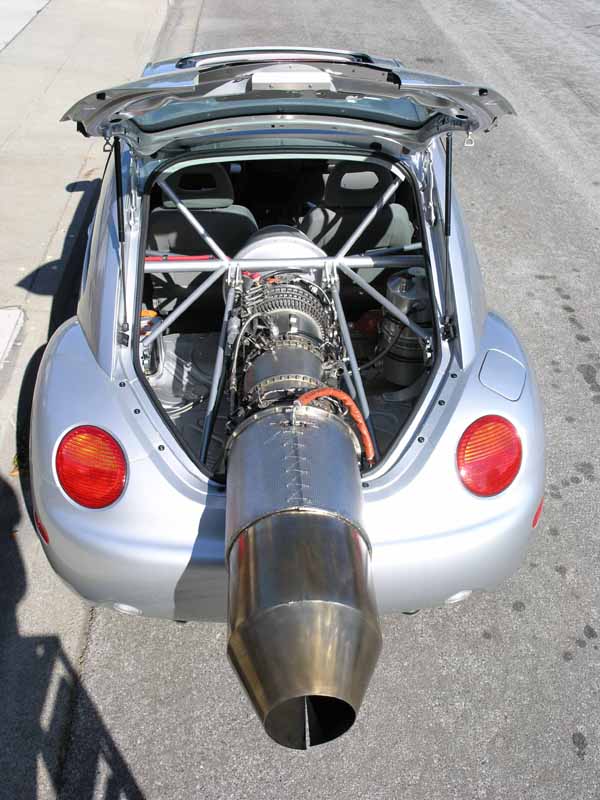 Ron Patrick, a mechanical engineer from Stanford, affixed a jet engine to his VW Bug. He says, "The response... has been fantastic. This car attracts crowds better than any '32 Ford." Myth Busters recreated the incident, but were not able to get their vehicle airborne. The author of the JATO legend would enjoy a cult notoriety were his identity known today. Several claim ownership of the idea of strapping a jet engine onto a vehicle. Read this entertaining 25,000-word mini-novel, Railroad Cart, a well-loved description of what NOT to do if your father owns a scrapyard.
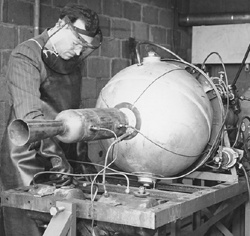 Edson C. Hendricks says, "Baffles me why anyone would believe the JATO story, because it's physically implausible. Attaching a modern JATO to an automobile so that it will not tear free on firing would be a remarkable engineering feat. Anyone smart enough to accomplish that, would also be smart enough to be nowhere near when the JATO is fired! Leaving that aside, as long as the car stays on the ground, the wheels would have sufficient friction to keep the motion straight, although they would probably lack the traction to maintain stability. Once the contraption became airborne, there would be NOTHING to stabilize the flight. Those doodads on airplanes like wings and tail assemblies are not only for style, but to keep the aircraft level. An airborne automobile propelled by an attached JATO would slam nose down into the ground in very short order." (JATO Unit Photo: Courtesy of Jean and NASA.)
Orphiucus says: "This reminds me of a colleague's reminiscence, which may be the basis of the JATO story. He was a military pilot In the 50's in Guam, when two men strapped not one but two JATO engines to the back of a military Jeep. They took it to Guam's 3-mile airstrip and ignited the engines, which hurled them 200 yards down the runway before the Jeep, now travelling at more than 300 mph, disintegrated. The men were shredded to bits, and the engines broke free from the remains of the jeep and darted wildly around the base before burning out. A film of this incident exists, in a military archive or maybe in a shoebox in someone's attic. "
Scott McClave says: "Andy Granitelli ran the legendary STP Indy car racing teams of the 60's and 70's. This tale is from his book, They Call Me Mister 500. Granitelli had experimented with strapping a JATO rocket to a car back in the late 40's. They first tried just one JATO rocket attached to an open-wheel hot rod, with little success. (Later they discovered that the first rocket was a dud.) Thinking they needed more power, they tied multiple JATO rockets to a single start button. Fortunately for Granetelli, only one rocket fired, which still propelled the car well over 150 mph. That was enough to convince him to stop experimenting with JATO rockets. Why did Grantelli survive to tell the story? Because the JATO of the 40's was first-generation, designed to lift a single-engine Navy bomber off the deck of an aircraft carrier. The JATO rocket of today has significantly more thrust, and is typically used to lift a large four-engine C-130 transport off a short, primitive runway. A car just can't keep the modern rocket on the ground."