Originally Posted by Franc Rauscher
A true ram jet has no turbines.
How does it get started?
Air must be moving through the chambers which are a venturi with fuel nozzles and a spark plug in the after chamber.
If the incoming air is not of a higher pressure than the ambient you don't get an engine providing thrust. You get a bomb.
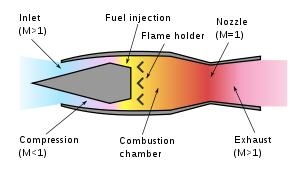
A
ramjet, sometimes referred to as a
stovepipe jet, or an
athodyd, is a form of
jet engine using the
engine's forward motion to compress incoming air, without a rotary compressor. Ramjets cannot produce thrust at zero airspeed and thus cannot move an aircraft from a standstill.
AHEM!
roadster with a stick
AHEM lol
ramjet engine
Unfortunately there are two things that work against the ramjet:
- Operating Speed
Unlike pulsejets and jet-turbine engines, the ramjet will not operate unless it is moving through the air at a speed of at least 400 mph.
If you attempt to start a ramjet while it's stationary or moving to slowly then it will give little or no thrust -- in fact you'll just get lazy, smokey flames billowing out both the intake and exhaust.
This is because a ramjet relies on heating a fast-moving stream of cold air as it enters the engine and then expelling that air at a higher speed out the back. Unless the engine is moving rapidly through the air there's nothing for the burning fuel to heat.
- Fuel Consumption
As a general rule of thumb, the fuel-efficiency of an internal combustion engine is related to the compression ratio at which it operates. That is to say -- the more the air/fuel mixture is compressed before it is ignited then the more power you'll get from a given amount of fuel.
Diesel engines have a compression ratio of about 20:1, most car engines operate at compression ratios as high as 11:1, a pulsejet runs at a compression ratio of less than 2:1 and ramjets are about the same at low speeds. As a result, the ramjet (like the pulsejet) is not a particularly fuel-efficient engine. What makes it worse is that since the ramjet needs to be operated at very high speed, it's going to have to burn a lot of fuel just to overcome the drag it creats at that speed.
Thrust is a function of expanding gases due to heat. There is no pressure gain until combustion occurs. Venturii do not create pressure, they modify airflow charicteristics. Nozzle flow is a function of mass/volume flow rate between 2 points, with 1 area larger than the other. The idea of ram air is not applicable at the speeds a car can reach... and the ramjet engine isn't useful in any automotive application