


LED tail lights


Thread Starter
|
Forum Regular
Joined: Nov 2017
Posts: 521
Likes: 19
From: Alexandria, Kentucky
 LED tail lights
What LED tail light bulbs has been used successfully in our Crossfire's. I'm talking about the brake lights and the turn signals.
What's the deal with resistor's or whatever their called, that should be installed with the LED's? Isn't there a plug and play LED that is a simple install? I don't understand electronic's well at all, so, if someone can point me in the right direction for this I would appreciate it very much. If there is a booklet or something on the web that address's this, let me know.
Thanks,
Jim
What's the deal with resistor's or whatever their called, that should be installed with the LED's? Isn't there a plug and play LED that is a simple install? I don't understand electronic's well at all, so, if someone can point me in the right direction for this I would appreciate it very much. If there is a booklet or something on the web that address's this, let me know.
Thanks,
Jim

Joined: Aug 2017
Posts: 138
Likes: 1
From: south florida
Re: LED tail lights
if you are going to use LED bulbs, you need to make certain that they are CANBUSS bulbs (those unfortunately are not all the same, but i have had excellent luck with bulbs from superbrightleds.com). i have used canbuss bulbs to replace the interior "dome" lighting, the trunk light (i have an srt6 roadster), the glove box light and bought the license plate mercedes lamp replacements (there are 2 license plate lights) that you can find information about here with a thread search (sorry i don't have the link). i haven't had any problems with the LED bulbs i purchased. non CANBUSS bulbs do not have a built in resistor (in simple terms) and will indicate a bulb out dash warning light more likely than not. the basics are that LED bulbs draw much less amperage than standard bulbs so they create a false bulb out indication to the system, hence the bulb out indicator on the dash.i have a pair of brake light led bulbs currently on their way to me so i feel comfortable that they will function properly also.
good luck
steve
good luck
steve
Last edited by srs244; Apr 9, 2019 at 11:33 AM.

Senior Member
Joined: Apr 2006
Posts: 25,432
Likes: 650
From: Ontario
Re: LED tail lights
What LED tail light bulbs has been used successfully in our Crossfire's. I'm talking about the brake lights and the turn signals.
What's the deal with resistor's or whatever their called, that should be installed with the LED's? Isn't there a plug and play LED that is a simple install? I don't understand electronic's well at all, so, if someone can point me in the right direction for this I would appreciate it very much. If there is a booklet or something on the web that address's this, let me know.
Thanks,
Jim
What's the deal with resistor's or whatever their called, that should be installed with the LED's? Isn't there a plug and play LED that is a simple install? I don't understand electronic's well at all, so, if someone can point me in the right direction for this I would appreciate it very much. If there is a booklet or something on the web that address's this, let me know.
Thanks,
Jim
I have replaced all existing interior and added some interior LED lights and there is no dash warning light on.
Thread Starter
|
Forum Regular
Joined: Nov 2017
Posts: 521
Likes: 19
From: Alexandria, Kentucky
Re: LED tail lights
srs244 - At the risk of sounding out to lunch, what are CANBUSS bulbs? From your paragraph it sounds like they have something special about them that they do NOT need a resistor. Since you have used them on interior lights, have you tried them on brake lights and turn signal lights? That's where I want to use them, on the brake and turn signal sockets. Of course, I don't want any light showing a bulb out, on the dash.
180, what LED's did you use for the brake and turn signals on your cars? Were they a plug in and go or did you have to use the resistor? I did see something on the web that you could replace the flasher that is used for the turn signals with one for use with LED's but I've searched all three volumes of my Crossfire manuals and could not find the location of the flasher. There is a wiring schematic for the flasher but no location is listed. There is a location for a multi-purpose switch located in the steering column, under the horn. Could that be it? If it is, why in the hell can't Mercedes and Chrysler call it a turn signal "flasher"? Let's not go there!
I guess if I am going to put LED's in the rear brake and turn signal sockets, right and left, I will just need the resistor on the turn signal socket and not the brake socket. I'm assuming the brake socket and bulb will be like a interior bulb with no resistor. Only the turn signal will need the resistor. Am I correct? If there is no resistor on the brake bulb and socket, will I get a bulb out light on the dash?
Let me know, Guy's,
Jim
180, what LED's did you use for the brake and turn signals on your cars? Were they a plug in and go or did you have to use the resistor? I did see something on the web that you could replace the flasher that is used for the turn signals with one for use with LED's but I've searched all three volumes of my Crossfire manuals and could not find the location of the flasher. There is a wiring schematic for the flasher but no location is listed. There is a location for a multi-purpose switch located in the steering column, under the horn. Could that be it? If it is, why in the hell can't Mercedes and Chrysler call it a turn signal "flasher"? Let's not go there!
I guess if I am going to put LED's in the rear brake and turn signal sockets, right and left, I will just need the resistor on the turn signal socket and not the brake socket. I'm assuming the brake socket and bulb will be like a interior bulb with no resistor. Only the turn signal will need the resistor. Am I correct? If there is no resistor on the brake bulb and socket, will I get a bulb out light on the dash?
Let me know, Guy's,
Jim
Joined: Aug 2017
Posts: 138
Likes: 1
From: south florida
Re: LED tail lights
what are referred to as CANBUSS bulbs are often referred to as "error free" bulbs also and are so defined because they have the necessary resistance built into the bulb and shouldn't create dash indicator light errors. just my opinion, but with modern LED bulb technology, i would not add resistors to wiring because they generate heat and most locations don't provide either the space or the ventilation to protect against that, but each to his own. supposedly a way around some of that would be to add a digital flasher to your system, but i'm not certain exactly how much of the exterior system that might cover. i'm sure 180 would be more knowledgeable than i on that. as far as LED technology, please keep in mind that without some type of resistance (like what is built into CANBUSS bulbs), some LED applications will have a tendency to flicker. that is even in systems that don't have dash indicator lights (canbus systems vs non canbus systems), so regardless , in my opinion, for virtually the same price a non canbuss bulbs it make no sense not to buy what are often referred to as "error free (canbuss) bulbs" regardless of the application (interior/exterior or whatever). i will have the taillight/stoplight LED bulbs recently ordered tomorrow and should have them installed over the weekend if you wish an updated report, but i do not anticipate a problem. i certainly don't hold myself out as an expert on anything, but can only relate my own personal experiences. i converted virtually every light (both in and out) on my 2004 commemorative edition corvette convertible to LED, but someone had marketed a "system" that was installed as an addition to the fuse panel which covered the entire lighting system both in and out.
Thread Starter
|
Forum Regular
Joined: Nov 2017
Posts: 521
Likes: 19
From: Alexandria, Kentucky
Re: LED tail lights
srs244 - Let me know how your brake and turn signal canbus bulbs work out. You mentioned that you used canbus LED's in a Corvette, but are you now going to install the bulb's you receive in a Crossfire? If they are going in a Crossfire, I would like to know how they work out, and their respective part numbers. I wrote to "Super Bright LED's" and they said I would have to have a resistor on both the brake light and the turn signal light. They did not mention anything about using canbus bulbs nor did they mention anything about the resistors building up heat. That leaves me confused.
Please keep me posted on how your canbus bulbs work out in your Crossfire.
Jim
Please keep me posted on how your canbus bulbs work out in your Crossfire.
Jim
Joined: Aug 2017
Posts: 138
Likes: 1
From: south florida
Re: LED tail lights
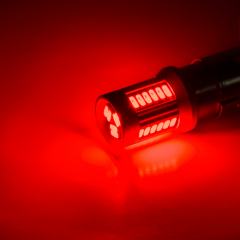
jim, the only purpose of a resistor is to resist the amount of power it passes through to another part of the circuit.. if you think of a toaster, all those coils that you see inside are a form of resistor (not literally, but figuratively) and when electricity passes through them there is resistance to the path and it produces the heat you see, and hence it toasts whatever is in the appliance. an electrical resistor performs the same function. it has full power leading up to it but resists it and passes through a reduced level of power. LED bulbs require significantly lower power to operate but the canbus system in the crossfire is looking for a full power response or it triggers the lamp out indicator. that is an over simplification, but is gives you an idea as to how it works and why in the crossfire it is needed. i will be installing these bulbs in my srt6 crossfire roadster. my corvette is all led from interior, headlamps to led halo sequential tail lights. never had a problem with even 1 bulb on the vette. i purchased canbus red led taillight bulbs that come up when you enter the vehicle information on that website. the bulb (part) number is 1157-R30-CBT-2PK: Red - 2 Pack. this is from their site:
Note: Newer vehicle electrical systems may require a CAN Bus bulb for operation.
Please consult your cars owners manual. View Details
 CAN Bus
Note: Newer vehicle electrical systems may require a CAN Bus bulb for operation.
Please consult your cars owners manual. View Details
CAN Bus1157 CAN Bus LED Bulb - Dual Function 30 SMD LED Tower - BAY15D Bulb - Red
$9.95 ea.QtyOrders Ship Today! 4 Hours and 57 Minutes remainingLast edited by srs244; Apr 10, 2019 at 11:23 AM.
Thread Starter
|
Forum Regular
Joined: Nov 2017
Posts: 521
Likes: 19
From: Alexandria, Kentucky
Re: LED tail lights
Thanks for the information. I understand now. Still though, let me know how the canbus bulbs work out in your SRT6. If they work OK I might just try them too and not use the resistor.
Thanks,
Jim
Thanks,
Jim
Joined: Aug 2017
Posts: 138
Likes: 1
From: south florida
Re: LED tail lights
ok, here's the follow up: after installing the LED canbus bulbs, on initial engine start up, no indicator lamp. approximately 30 seconds or so later, the lamp does come on. apparently, the ECM (or whatever determines a lamp out condition) initially accepts the resistor level built into the can bus bulb but eventually recognizes that there isn't enough load on that circuit and produces a fault, triggering the indicator lamp on the dash. i asked a couple of people who should know what was up, (much more so than me) and they indicated that each manufacturer may differ in the load necessary to trigger or not trigger a "fault" in the system and the only solution would be to add in a 6 ohm resistor to that application. apparently, the resistor level in the "no error" canbus bulbs is pretty standard, and even though there might be differences in different bulbs it isn't worth the time to experiment with numerous bulbs to see if you can find one that might actually work without a load in the line. i'm sure there are plenty of folks here who may have played around with the same thing and many persons with lots more knowledge than me might be able to contribute an alternate LED bulb usage solution if there is one.

Joined: Nov 2017
Posts: 149
Likes: 2
From: El Paso, TX
Re: LED tail lights
[QUOTE=srs244;921621]what are referred to as CANBUSS bulbs are often referred to as "error free" bulbs also and are so defined because they have the necessary resistance built into the bulb and shouldn't create dash indicator light errors. just my opinion, but with modern LED bulb technology, i would not add resistors to wiring because they generate heat and most locations don't provide either the space or the ventilation to protect against that, but each to his own.
That's true, any added resistor will generate heat, but it should be no problem. A 3 Watt incandescent (original equipment) bulb will generate 3 Watts of heat - that's the way they're specified; so the heat generated by a resistor would be 3 Watts (or a bit less), to avoid the dash indicator light. I agree that the problem with adding a resistor is its size: You may not have room for it. Yes, CANBUS is the way to go.
That's true, any added resistor will generate heat, but it should be no problem. A 3 Watt incandescent (original equipment) bulb will generate 3 Watts of heat - that's the way they're specified; so the heat generated by a resistor would be 3 Watts (or a bit less), to avoid the dash indicator light. I agree that the problem with adding a resistor is its size: You may not have room for it. Yes, CANBUS is the way to go.
Last edited by ambidextrous; Apr 13, 2019 at 11:17 AM.
Thread Starter
|
Forum Regular
Joined: Nov 2017
Posts: 521
Likes: 19
From: Alexandria, Kentucky
Re: LED tail lights
Thanks, everyone, for the very honest and valuable information. I think I will just stay with the original specified bulb's. That's a lot less trouble and they are effective for their purpose. I was hoping for a rather simple pay and play situation.
Thanks again to everyone,
Jim
Thanks again to everyone,
Jim
Joined: Aug 2017
Posts: 138
Likes: 1
From: south florida
Re: LED tail lights
ok, since i have decided to be a guinea pig and try led stop/tail lamps, can someone who installed resistors for that application provide me with a wiring diagram of how they put the resistor into the socket wiring to solve the lamp out error>?? i tried searching "resistor" but none of the led lamp threads that i searched through seemed to indicate how to wire the resistor into the socket wiring to rid the dash of the lamp out indicator light.
thanks for the help
steve
thanks for the help
steve
Joined: Nov 2017
Posts: 149
Likes: 2
From: El Paso, TX
Re: LED tail lights
ok, since i have decided to be a guinea pig and try led stop/tail lamps, can someone who installed resistors for that application provide me with a wiring diagram of how they put the resistor into the socket wiring to solve the lamp out error>?? i tried searching "resistor" but none of the led lamp threads that i searched through seemed to indicate how to wire the resistor into the socket wiring to rid the dash of the lamp out indicator light.
thanks for the help
steve
thanks for the help
steve
Joined: Aug 2017
Posts: 138
Likes: 1
From: south florida
Re: LED tail lights
something must have gotten lost in the translation of all the posts..........i have installed canbus LED bulbs (and my supplier/seller gave me the explanation already stated in post 10) and still get the lamp out indicator light on the dash. if you have a canbus bulb that solves that issue, i would be more than happy to have the information (like the link to the seller and the part number there) and give it a try. if not, join the club. at this point i am seeking either the can bus bulb that solves the problem, or someone's help with a wiring diagram of how they put the resistor into the socket harness..

Senior Member
Joined: Jul 2009
Posts: 6,372
Likes: 810
From: Central South Carolina
Re: LED tail lights
something must have gotten lost in the translation of all the posts..........i have installed canbus LED bulbs (and my supplier/seller gave me the explanation already stated in post 10) and still get the lamp out indicator light on the dash. if you have a canbus bulb that solves that issue, i would be more than happy to have the information (like the link to the seller and the part number there) and give it a try. if not, join the club. at this point i am seeking either the can bus bulb that solves the problem, or someone's help with a wiring diagram of how they put the resistor into the socket harness..
 OK, let me ask one thing to be clear about your issue. IF you replace those 'canbus' bulbs with regular incandescent brake light bulbs, does that 'lamp out' light turn off? Just making sure it is the new bulbs you put in that is tripping the lamp out light. Thanks.
 .
Joined: Nov 2017
Posts: 149
Likes: 2
From: El Paso, TX
Re: LED tail lights
something must have gotten lost in the translation of all the posts..........i have installed canbus LED bulbs (and my supplier/seller gave me the explanation already stated in post 10) and still get the lamp out indicator light on the dash. if you have a canbus bulb that solves that issue, i would be more than happy to have the information (like the link to the seller and the part number there) and give it a try. if not, join the club. at this point i am seeking either the can bus bulb that solves the problem, or someone's help with a wiring diagram of how they put the resistor into the socket harness..
.https://www.ebay.com/itm/White-Car-L...UAAOSwWkJY9cde
Joined: Aug 2017
Posts: 138
Likes: 1
From: south florida
Re: LED tail lights
Thanks, but you have it backwards. I installed can bus LED bulbs. The resistors in them don't provide sufficient resistance to fool the electric system on my crossfire. So......... I am looking for the information on an Led bulb that does work to fool the indicator light or the wiring diagram for insertion of the resistor into the stop/tail lamp harness. Obviously I would prefer the bulb that works but will settle to insert a resistor.
Thread Starter
|
Forum Regular
Joined: Nov 2017
Posts: 521
Likes: 19
From: Alexandria, Kentucky
Re: LED tail lights
srs244 - I wrote to "Super Bright LED's" and specifically to a "Wade Fox" in the tech department about the can-bus bulbs. He said that the bulb's for the Crossfire are can-bus and that the correct number's are 1157-CW30-CBT for the brake light and BAU15S-A30-CBT for the turn signal. I've not tried these so I don't know if they accomplish what your looking for or not. If you look up SuperbrightLEDs.com you will find their contact information and you can call them for direct information. Hope this helps. Let me know what you find out and if you try them, how they work out.
Jim
Jim

