


Trojans and Greeks?


Thread Starter
|
Administrator
Joined: Jun 2009
Posts: 13,970
Likes: 1,295
From: Fort Worth, Texas
 Trojans and Greeks?
It sounds painful - are deadly asteroids stuck in earths lagrangian points?
The idea of a "Lagrange Point" is fairly simple:
Lagrangian points in planetary systems are islands of gravitational stability. They are volumes of space where the gravity of two massive bodies cancel out. The first two Lagrangian points in the Earth-Sun system are fairly obvious. The L1 point is located directly between the Earth and Sun, about 1.5 million km from the surface of the Earth, the point at which the gravitational pull of the Sun and Earth cancel each other out.
The L2 point is located at approximately the same distance, but on the opposite side of the Earth. In this case, the Earth is constantly eclipsing the Sun.
But the implications can be a bit overwhelming:
It is a known fact that other planets in the Solar System possess these islands of gravitational calm, and asteroids have been observed sitting in stable locations in front and behind of Jupiter's orbit for example (called "Trojans" and "Greeks"). Does Earth have a swarm of asteroids sitting in its L4 and L5 points? Scientists believe this is a certainty.
"Big deal, Pizzaguy, why do I care if there are asteroids sitting out there? The piece says that the darn things are stable."
Well, a friend of mine on the spaceport observed:
Apparently because of the relative position of these Lagrangian points, they can not be viewed from earth as they are too close to the terminator between day and night. As I read this article another thought occurred to me, which the article did not make reference to. I wondered how often a comet, or passing near earth asteroid not on a collision course with earth but close enough to L4 and L5 would encounter an asteroid in one of those islands of calm and dislodge it. Such an event could potentially cause an orbital shift to one of those asteroids sending it to earth. The idea was not mentioned, but it is a possibility just as surely as there may be trapped asteroids in those orbits. Anyway, food for thought. Perhaps we might want to take another look... a 3-d look at the near earth asteroids we already know and see if any of them come close to our L points.
Impressive thought for a fire-fighter-turned-truck-driver. It makes the idea of a "doomsday asteroid" a bit more realistic. Perhaps.
The idea of a "Lagrange Point" is fairly simple:
Lagrangian points in planetary systems are islands of gravitational stability. They are volumes of space where the gravity of two massive bodies cancel out. The first two Lagrangian points in the Earth-Sun system are fairly obvious. The L1 point is located directly between the Earth and Sun, about 1.5 million km from the surface of the Earth, the point at which the gravitational pull of the Sun and Earth cancel each other out.
The L2 point is located at approximately the same distance, but on the opposite side of the Earth. In this case, the Earth is constantly eclipsing the Sun.
But the implications can be a bit overwhelming:
It is a known fact that other planets in the Solar System possess these islands of gravitational calm, and asteroids have been observed sitting in stable locations in front and behind of Jupiter's orbit for example (called "Trojans" and "Greeks"). Does Earth have a swarm of asteroids sitting in its L4 and L5 points? Scientists believe this is a certainty.
"Big deal, Pizzaguy, why do I care if there are asteroids sitting out there? The piece says that the darn things are stable."
Well, a friend of mine on the spaceport observed:
Apparently because of the relative position of these Lagrangian points, they can not be viewed from earth as they are too close to the terminator between day and night. As I read this article another thought occurred to me, which the article did not make reference to. I wondered how often a comet, or passing near earth asteroid not on a collision course with earth but close enough to L4 and L5 would encounter an asteroid in one of those islands of calm and dislodge it. Such an event could potentially cause an orbital shift to one of those asteroids sending it to earth. The idea was not mentioned, but it is a possibility just as surely as there may be trapped asteroids in those orbits. Anyway, food for thought. Perhaps we might want to take another look... a 3-d look at the near earth asteroids we already know and see if any of them come close to our L points.
Impressive thought for a fire-fighter-turned-truck-driver.
It makes the idea of a "doomsday asteroid" a bit more realistic. Perhaps.
Thread Starter
|
Administrator
Joined: Jun 2009
Posts: 13,970
Likes: 1,295
From: Fort Worth, Texas
Re: Trojans and Greeks?
Look what I found here:
Lagrange
What are "Lagrange points", also known as "libration points" or "L-points"? These are all jargon for places where a light third body can sit "motionless" relative to two heavier bodies that are orbiting each other thanks to the force of gravity.
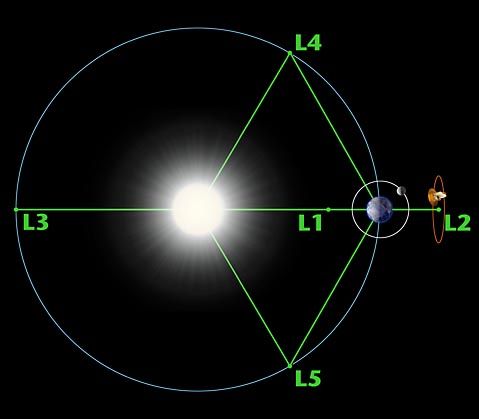
The really interesting thing is that the Lagrange points L4 and L5 are stable equilibria as long as the heavy body - the Sun in our example - is more than 24.96 times as massive as the intermediate-sized one. In other words, a small body put in orbit at the right speed at either of these points will tend to stay there! If you nudge it a little, it will drift back. On the other hand, L1, L2, and L3 are unstable equilibria: the slightest nudge will make satellite at one of these points drift away. To keep it there, you'll need to equip it with thrusters that keep correcting its orbit now and then.
Cool! Think of the implications of a space-colony or station at such a point! What a coo place to observe the universe from.

Lagrange
What are "Lagrange points", also known as "libration points" or "L-points"? These are all jargon for places where a light third body can sit "motionless" relative to two heavier bodies that are orbiting each other thanks to the force of gravity.
The really interesting thing is that the Lagrange points L4 and L5 are stable equilibria as long as the heavy body - the Sun in our example - is more than 24.96 times as massive as the intermediate-sized one. In other words, a small body put in orbit at the right speed at either of these points will tend to stay there! If you nudge it a little, it will drift back. On the other hand, L1, L2, and L3 are unstable equilibria: the slightest nudge will make satellite at one of these points drift away. To keep it there, you'll need to equip it with thrusters that keep correcting its orbit now and then.
Cool!
Think of the implications of a space-colony or station at such a point! What a coo place to observe the universe from.Last edited by pizzaguy; Dec 15, 2009 at 10:22 AM.


Thread
Thread Starter
Forum
Replies
Last Post
Currently Active Users Viewing This Thread: 1 (0 members and 1 guests)